

By Jenny Mitchell, JMitchell Resilient Homes
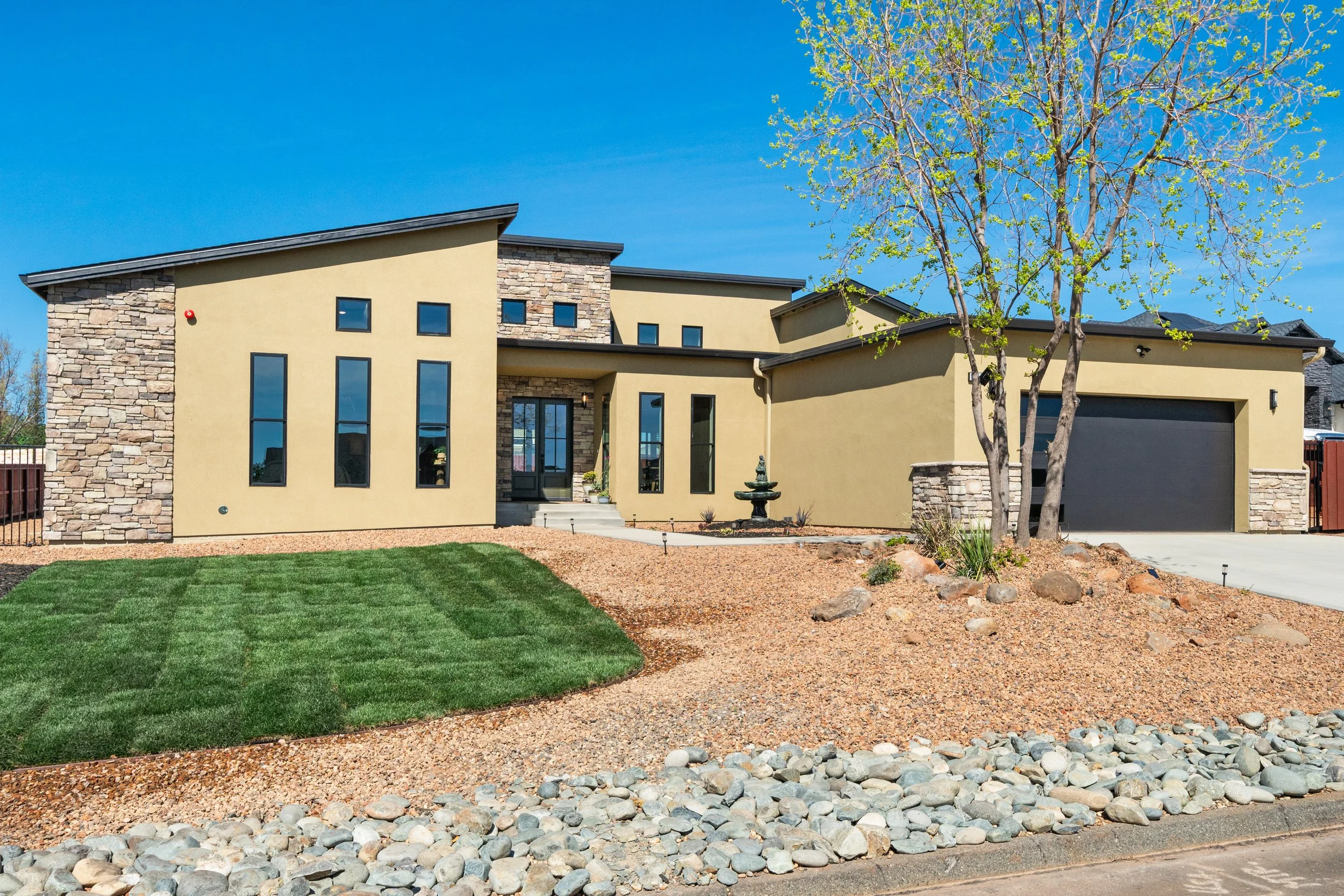
5093 Malibu Drive, Paradise, CA
Note: The figures in this post are based on two real homes I own, one a conventionally built wood-frame home I have lived in for years, one a home I designed and built in Paradise, California. Bay Area utility figures reflect my actual monthly billing averages across a full year. Paradise PG&E figures reflect actual monitored data from an unoccupied home with pool equipment and HVAC running. Paradise water figures are based on Paradise Irrigation District municipal rates, estimated for a normally occupied home. Maintenance costs marked (est.) are reasonable estimates based on published sources cited at the bottom of this post. All insurance figures are actual policy costs from Farmers Insurance. Property taxes and purchase price are excluded.
Two Homes. One Design Philosophy.
One home was built the way most California homes are built, wood framing, conventional systems, code minimum. It is a good house. My husband and I raised our family there. It is 3,250 square feet, 4 bedrooms, 4 bathrooms, a pool, well-maintained, built in 2000. It is also expensive to run, and it is getting more expensive every year. Our insurance has doubled in the last three years.
The other I designed myself in Paradise, California, on land I owned, after watching the Camp Fire take nearly everything around it. I designed it from the inside out: around how the people living there would actually use it, around the California climate, around what a home needs to cost to own and operate over 30 years, not just to build. The design starts with the life intended for it. The materials and systems follow from that. Reinforced concrete exterior walls. Net Zero energy performance. Low-water landscape. A wall assembly with a 4-hour fire rating.
This post is the cost comparison between those two homes. The numbers are real. The gap is significant.
A Note on California Insurance
Standard homeowners insurance in California covers fire, liability, water damage, falling trees, and other incidents in a single bundled policy. In high fire-risk areas, many carriers have stopped writing those policies entirely. Homeowners who can still get coverage are seeing premiums double and triple.
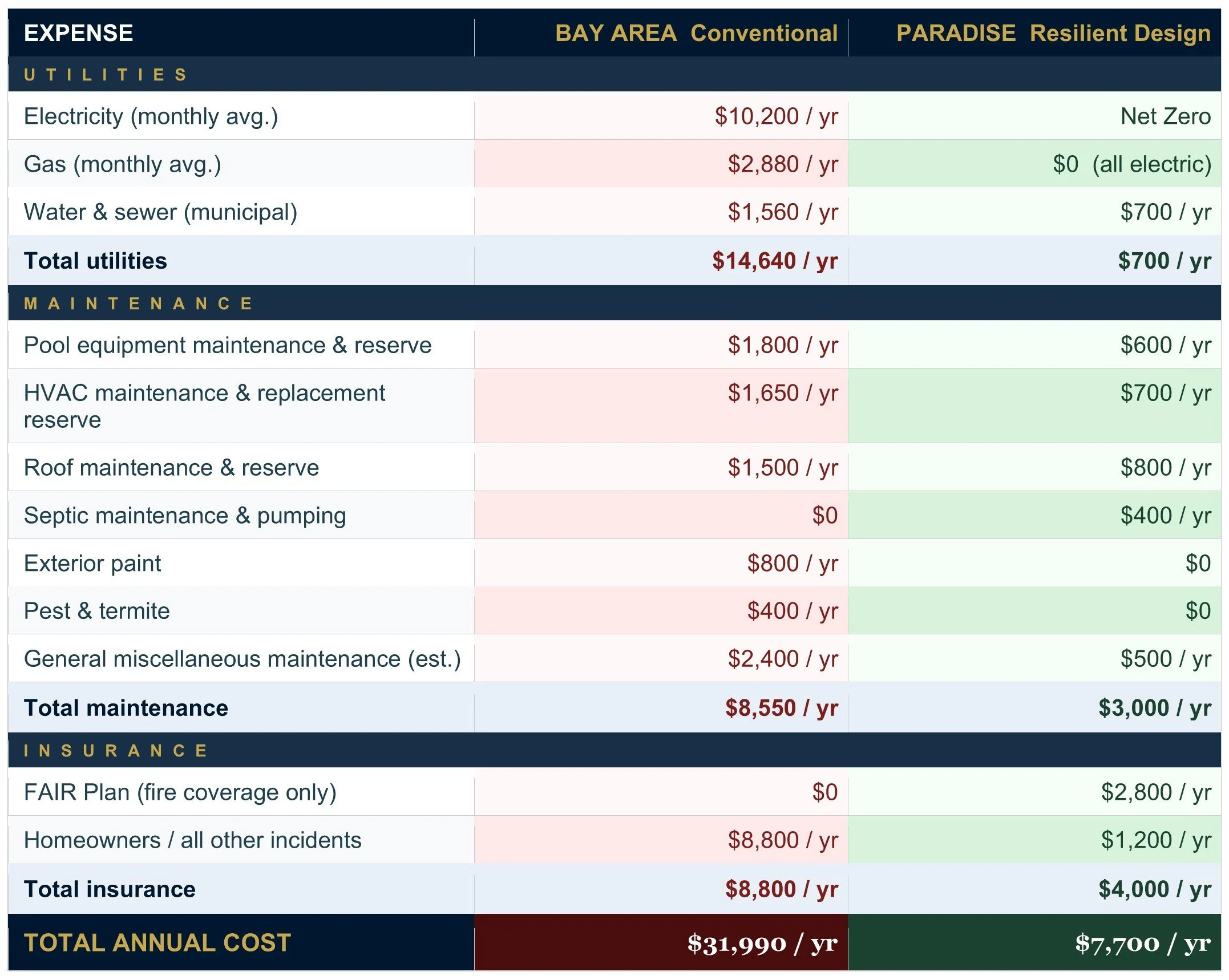
The Paradise home carries a FAIR Plan policy for fire coverage, written through Farmers Insurance. The FAIR Plan offers wildfire hardening discounts to policyholders who meet specific construction and site requirements. This home qualifies for every available hardening discount, which is what produces the $2,800 annual premium. A separate policy covering liability, water damage, and other incidents is required alongside the FAIR Plan. The $1,200 shown here reflects the author’s actual policy cost, personal property coverage within that policy will vary based on what each homeowner chooses to insure. Total insurance shown: $4,000 per year.
The Bay Area wood-frame home carries a single bundled homeowners policy at $8,800 per year; fire, liability, and all other incidents combined. Both figures are actual quotes from Farmers Insurance.
Annual Operating Expenses — Line by Line
Property taxes and purchase price are excluded. Everything else that costs money every year is included.
A note on maintenance costs: The roof, HVAC, and pool equipment line items include both routine annual maintenance and an amortized replacement reserve, meaning a portion of the annual cost is set aside each year toward the eventual replacement of that system. Even brand new equipment carries a reserve because replacement costs money when it arrives 15 to 25 years from now. Accounting for this reserve is what makes a 30-year cost comparison honest. General miscellaneous maintenance is marked (est.) as a reasonable estimate based on published sources.
Three Scenarios — Not Two
I want to be fair about this. If you love the home you are in and are not ready to leave it, there are meaningful upgrades you can make; solar, electrification, new pool equipment. So I ran those numbers too.
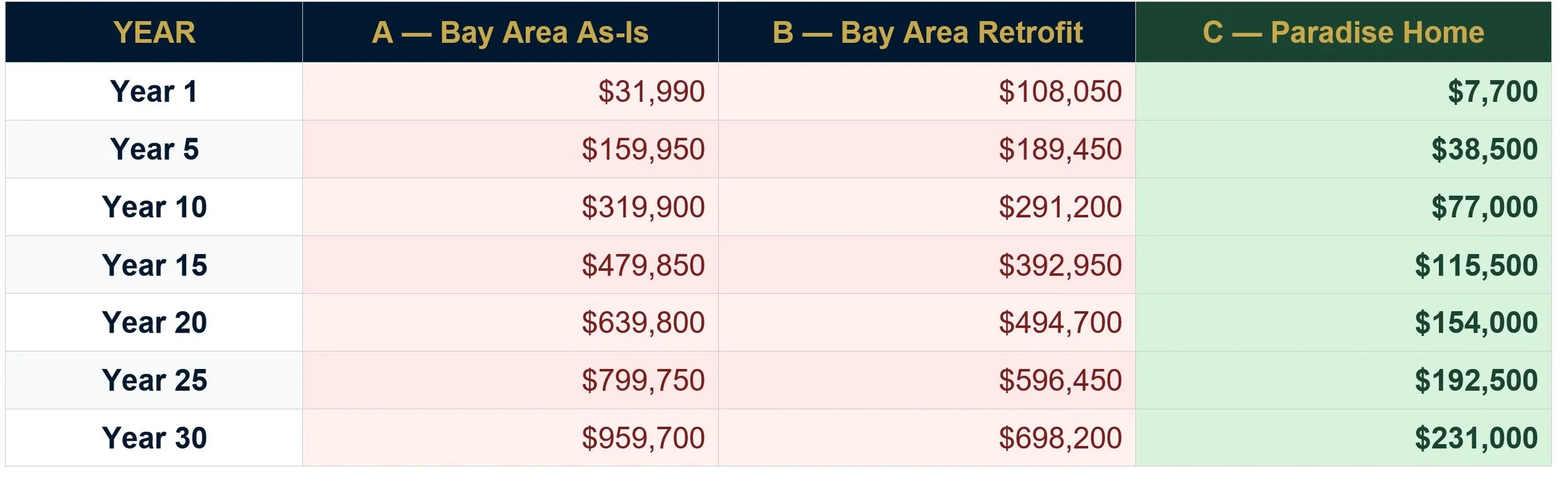
Scenario A is the Bay Area home as it stands today. Scenario B is the same home after a full electrification retrofit; solar, heat pumps, new pool equipment, gas eliminated. Scenario C is the Paradise home.

The Retrofit Math
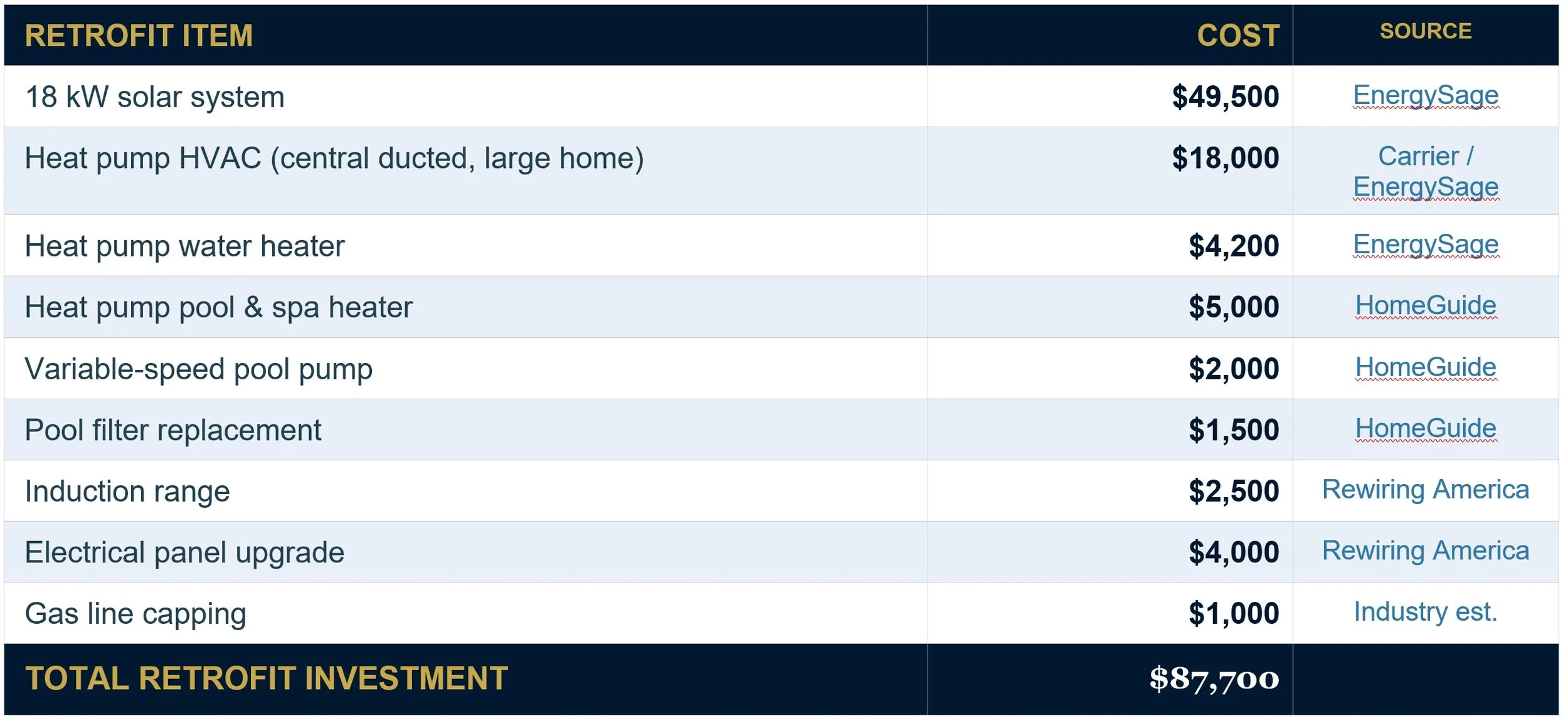
A full electrification retrofit on the Bay Area home; solar, heat pump HVAC, heat pump water heater, heat pump pool and spa heater, new pool equipment, induction range, panel upgrade, gas line capped, would cost approximately $87,700. It would eliminate the gas bill and reduce electricity costs significantly. Here is the full equipment list.
What the retrofit does and does not do
The retrofit eliminates the gas bill and dramatically reduces electricity costs. After an $87,700 investment, the Bay Area home’s annual utility cost drops from $14,640 to approximately $3,000 per year.
But the retrofit does not touch the maintenance gap or the insurance gap. The exterior walls are still wood, they still require painting, pest control, and a roof on a predictable replacement cycle. None of those structural realities change because solar panels and heat pumps were added.
After spending $87,700, the retrofitted Bay Area home still costs approximately $12,650 more per year to own and operate than the Paradise home because the retrofit does nothing for insurance, and conventionally built homes in California fire country will continue to carry higher premiums regardless of any upgrades made.
Why the Paradise Home Needs Less Solar
The Bay Area retrofit requires an 18 kW solar system to offset a home consuming approximately $10,200 per year in electricity, a high-usage home with aging pool equipment, 25-year-old HVAC, and gas loads shifting to electric after retrofit. The Paradise home was designed and built Net Zero Energy with a 4.2 kW system.
California’s Title 24 energy code calculates required solar size based on a home’s actual energy demand. The concrete exterior walls, their continuous insulation, and the absence of thermal bridging reduce the heating and cooling load so significantly that the home qualifies for a system less than one-quarter the size of the retrofitted Bay Area home. Per California Energy Commission Title 24 calculations, a conventionally built home of this size in most California climate zones requires 7 to 10 kW to reach Net Zero from a baseline standpoint. The Bay Area home’s actual consumption pushes that requirement to 18 kW.
In the Paradise home, the building envelope, the reinforced insulated concrete system, is doing the work that the solar system does not have to. That means a smaller system to install, a smaller system to maintain, and a home that is genuinely less dependent on the grid, not just offset against it.
What These Numbers Mean Over Time
The table below shows cumulative operating costs; utilities, maintenance, and insurance combined for all three scenarios over 30 years. Scenario B Year 1 includes the $87,700 retrofit investment. All figures assume current costs remain flat.
What We Leave Behind
There is one more calculation that does not appear in any of these tables.
A conventionally built home at 40 or 50 years old carries the weight of its age. Deferred maintenance, aging systems, an insurance market that is increasingly uncertain for wood-frame construction in California. The heirs who receive it face a choice: invest significantly to restore it, or sell at a discount.
Concrete gains compressive strength over time rather than losing it, the opposite of wood framing, which deteriorates. The Roman Colosseum has been standing for two thousand years. That is not a coincidence. It is what the material does. The exterior walls do not rot, do not require painting, and do not carry the same fire exposure risk that makes conventionally built homes increasingly difficult to insure. Systems need updating. But the structure holds.
Every year the structure holds is a year the home gains rather than loses value. The cost advantage does not end when you do.
Why I Called This "The Home I Should Be Living In”
I built this home in Paradise because I believed in what a well-designed home could do. Not just structurally, though the structural case is compelling. But for the people living inside it. The design started with how someone would actually use this home, the rooms, the light, the connections between spaces, the landscape surrounding it. The concrete exterior walls, the mechanical systems, the solar array, the low-water planting. All of it followed from those decisions. It was not a floor plan I selected. It was a home I designed.
And then I sat down and looked at the operating costs, and I understood something I had not fully calculated before: the case for designing a home this way is not just philosophical. It is not just about resilience or legacy or what you leave behind. It is also simply about money.
I am paying $31,990 a year to own and operate a conventionally built home in one of the most fire-prone states in the country. I built a home that costs $7,700 a year, dramatically lower to operate, and designed from the inside out around the life lived within it.
The memories are made inside. The structure is what keeps them safe.
Why I'm Sharing This Publicly
I publish this comparison because the math itself is what matters.
I am one homeowner running this analysis on my own properties. But the dynamics behind the numbers are not specific to me. Tens of thousands of California families face the same insurance reality I do. Carriers retreating from high fire-risk zones. Premiums doubling and tripling. FAIR Plan rolls growing every quarter. The decision about how, where, and what to build in California is shifting underneath every owner in the state right now, and there are not enough working examples of what an alternative actually costs once it is built.
This post is one working example. If you are a real estate professional, an insurance broker, a financial advisor, or anyone whose work brings you into conversations with clients about California housing decisions, this comparison may be useful for those conversations. The numbers are sourced. The methodology is disclosed. The home itself is in Paradise, California, and you can visit it.
If a client of yours is:
Insurance-conscious about their next California home, or already non-renewed by their carrier
Displaced by recent California fires and weighing rebuild options
Downsizing from Bay Area, Sacramento, or another urban California market
A multigenerational household thinking thirty years out, not five
Approaching retirement and concerned about insurance volatility on a fixed income
This case study may be worth a forward.
We need more conversation in California real estate about what insurance-accessible, climate-resilient construction actually costs, and what it actually saves. I am publishing this in that spirit.
About 5093 Malibu Drive
The Paradise home referenced throughout this post is currently on the market.
5093 Malibu Drive, Paradise, California 3,358 sqft single-story · 4 bedrooms · 3 bathrooms · 0.43 acres $982,000 asking Move-in ready, pool, mountain views, 500 sqft California Room
Six-inch steel-reinforced concrete core within an approximately twelve-inch wall assembly. Continuous EPS foam insulation on both faces, stucco exterior, drywall interior. 4-hour fire rating. PG&E Net Zero certified. Owned 4.2 kW solar conveys with the property.
Seller is offering concessions toward buyer's agent compensation.
Full project details, photos, virtual tour, and the operating cost comparison: malibudrive.netlify.app
Listing agent: Hobie Jensen, Parkway Real Estate Co. · (530) 591-9686
Developer direct: Jenny Mitchell, JMitchell Resilient Homes · (530) 762-1655
Sources
• Bay Area electricity cost (monthly average): Author’s actual PG&E billing records, 12-month average
• Bay Area gas cost (monthly average): Author’s actual PG&E billing records, 12-month average
• Paradise municipal water rates: Paradise Irrigation District — pidwater.com (Residential rate: $42.97/month base + $1.61/HCF)
• HVAC annual maintenance cost: HomeGuide — homeguide.com/costs/ac-maintenance-tune-up-service-cost (2026)
• HVAC system lifespan (15–25 years): U.S. Department of Energy — energy.gov/energysaver
• Pool equipment maintenance and replacement reserve: HomeGuide — homeguide.com/costs/pool-pump-cost (2026)
• Roof maintenance — composition shingle: HomeGuide — homeguide.com/costs/roof-inspection-cost (2025)
• Roof maintenance — flat/torch-down: Angi — angi.com/articles/how-much-torch-down-roofing-cost.htm (2026)
• Septic maintenance and pumping: HomeGuide — homeguide.com (2025)
• General miscellaneous maintenance (est.) — Bay Area $2,400/yr based on national average adjusted for home age; Paradise $500/yr reflecting new construction and low-maintenance design: Fixr — fixr.com (2024)
• Homeowners insurance (both properties): Farmers Insurance — actual policy quotes, 2026
• 4-hour fire rating: ASTM E119-20 — standard test method for fire resistance of building construction and materials
• Net Zero certification: PG&E — property-specific certification, 5093 Malibu Drive, Paradise CA
• Solar system size (18 kW retrofit) and cost ($49,500): EnergySage — energysage.com; $2.50–$3.00/watt installed, no federal tax credit after Dec 31 2025
• Solar system size (4.2 kW Paradise home) and Title 24 requirements: California Energy Commission — 2022 Building Energy Efficiency Standards, Section 150.1(c)14, Equation 150.1-C — energy.ca.gov
• Heat pump HVAC installed cost ($18,000): Carrier — carrier.com; EnergySage Marketplace — ducted systems average $14,529 — energysage.com
• Heat pump water heater installed cost ($4,200): EnergySage — energysage.com (2026)
• Heat pump pool heater installed cost ($5,000): HomeGuide — homeguide.com/costs/pool-heater-cost (2026)
• Variable-speed pool pump installed cost ($2,000): HomeGuide — homeguide.com/costs/pool-pump-cost (2026)
• Pool filter replacement cost ($1,500): HomeGuide — homeguide.com/costs/pool-filter-replacement-and-installation-cost (2026)
• Induction range and electrical panel upgrade costs: Rewiring America — Upfront Cost of Home Electrification report — rewiringamerica.org