

By Jenny Mitchell, JMitchell Resilient Homes
I was not in Paradise when the Camp Fire started on November 8, 2018.
I was hundreds of miles away when my phone rang. It was my kids, both of them attending Chico State at the time, calling to tell me what was happening outside their windows. The sky had turned black. Not dark gray, not overcast. Black. In the middle of the day. They described putting on masks just to breathe outside. Streets filling with people who had nowhere to go. Paradise residents who had scrambled down the hill with whatever they could grab, flooding into Chico looking for family members they couldn't find, for pets, for gas, for any sign of what came next. The chaos was complete.
My kids weren't escaping the fire. They were on the edge of someone else's catastrophe watching it unfold from Chico, a few miles away. The smoke, the darkness at noon, the campus shutting down, the streets flooding with people who had lost everything and had nowhere to go. They came home shaken by what they had witnessed, not by what they had lost.
Eighty-five people died in the Camp Fire. Nearly 19,000 structures were destroyed. The town of Paradise a community of 27,000 people, built over generations was gone in a single morning.
It stayed with me too.
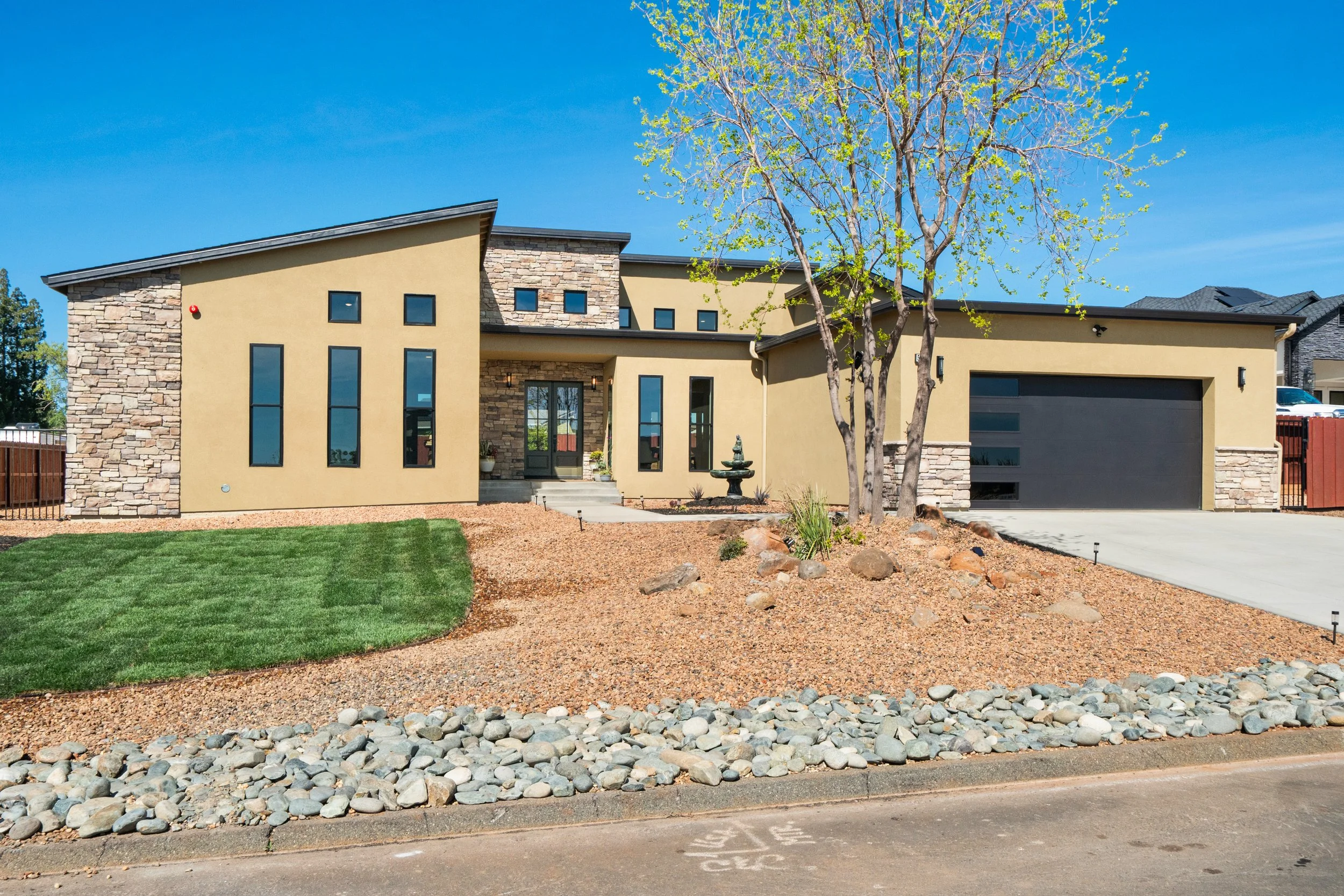
5093 Malibu Drive, Paradise. Insulated concrete fire-resistant home built 2026.
Photo courtesy of Jordan Claverie
What I Already Knew About Concrete
I grew up in the family concrete business. Before I knew what a career was, I knew what concrete was, how it behaved, what it could withstand, what it meant to build something that was meant to last. That early foundation shaped everything that came after.
I spent years in construction project management working on large-scale commercial projects in California, eventually leading a $550 million capital construction portfolio as a direct employee of one of the Bay Area's largest technology companies. I championed low-carbon concrete solutions that reduced the construction carbon footprint and influenced how a generation of Silicon Valley buildings were designed and specified. I became LEED AP BD+C and ILFI Accredited. I spoke at the Yale AIA Net Zero Energy Summit. I was published by Gates Ventures and Breakthrough Energy on sustainable construction.
I knew what concrete could do. I had spent my entire career working with it at scale.
What I had not done was bring that knowledge home, literally. To residential construction. To the kind of homes where families actually live.
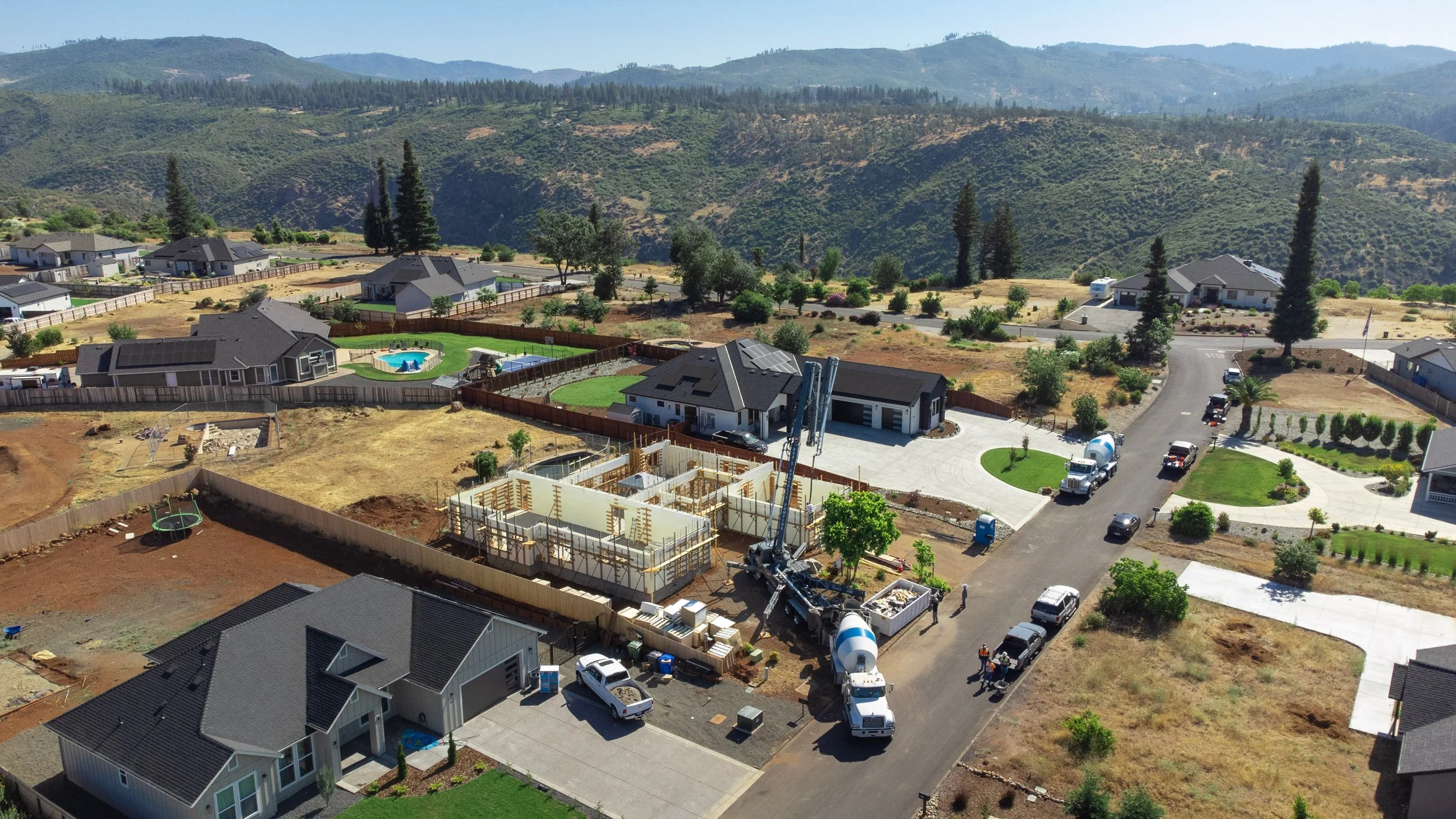
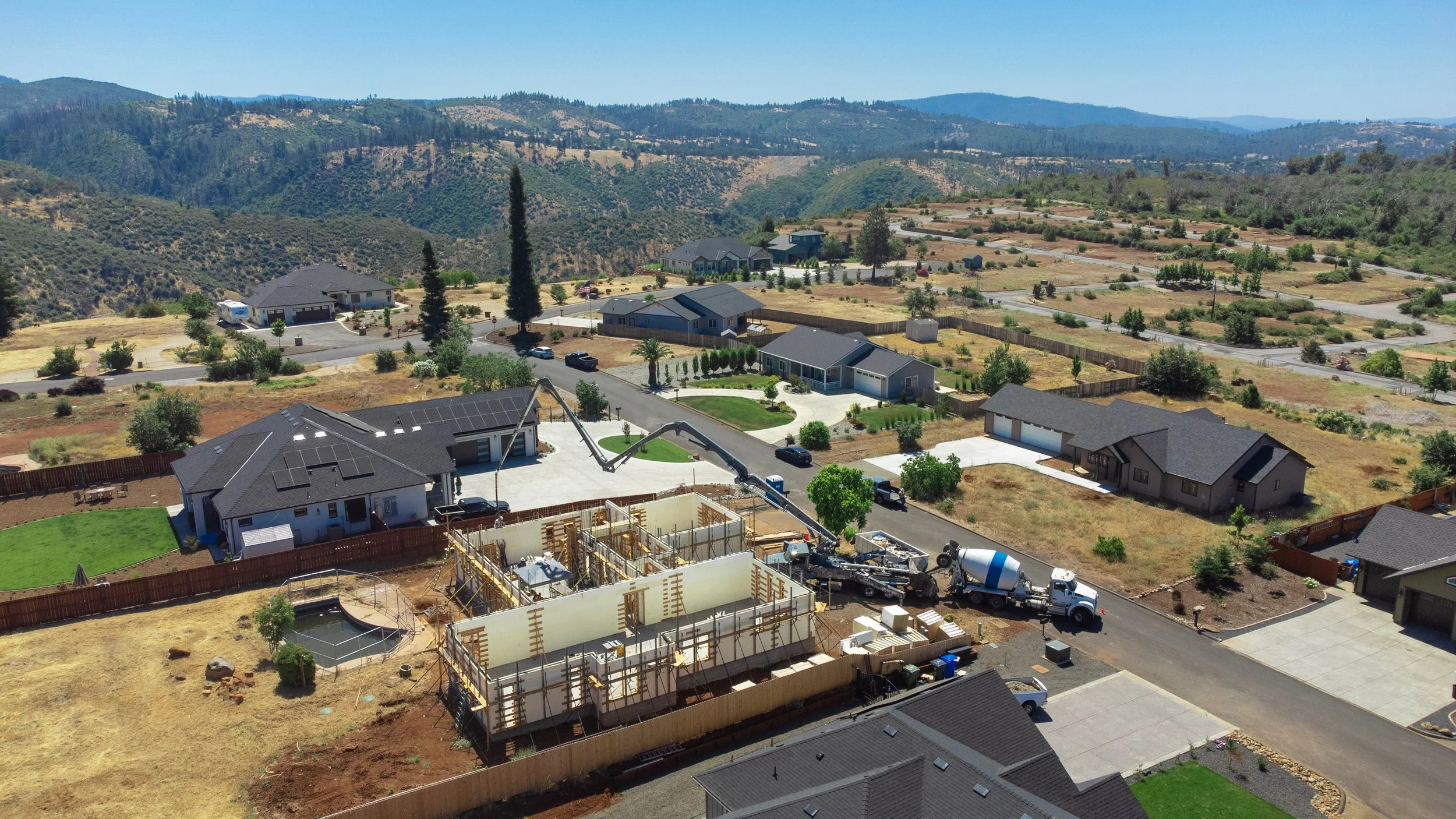
5093 Malibu Drive, Paradise, CA. Insulated concrete home, first lift. Summer 2025. Concrete is pumped and placed into the ICF forms. Photo courtesy of Matthews Ready Mix
After the Camp Fire, I kept thinking about what it would have taken for those homes to survive. Not a storm shelter. Not a safe room bolted to the garage floor. The house itself, the walls, the structure, the thing families had spent their lives paying for and living in, what would it take for that to still be standing?
I already knew the answer. I had known it professionally for years. Insulated Concrete construction, a fire resistant building system that had been used for over 50 years in hurricane zones and tornado alleys, where school districts build with it specifically because the buildings can serve as community shelters when disaster hits. Six inches of steel-reinforced concrete wrapped in continuous insulation. A wall system that is fire resistant by design. That doesn't burn. That doesn't blow away.
And concrete itself? People forget how old this material is. The Roman Colosseum was built with concrete nearly 2,000 years ago and is still standing. Concrete is not a modern innovation it is one of the most proven building materials in human history. Insulated concrete construction simply takes that ancient durability and combines it with modern insulation and engineering to produce a home that is both resilient and energy efficient. This is not an experiment. It is a 50 year old building system built on a 2,000 year old material.
The question was not whether insulated concrete could build a home that survived a wildfire. The question was why California wasn't building this way already.
The honest answer is likely cost. Insulated concrete has historically been more expensive upfront than wood-frame construction, and in a state where building costs are already among the highest in the country, it became associated with high-end custom homes, something available to people with larger budgets, not to families who had lost everything and were trying to figure out how to rebuild on fixed incomes and insurance settlements.
That felt wrong to me. The people who needed resilient construction most were the ones least able to pay a premium for it. I decided that was a problem worth working on.
Building in Paradise
In 2023 I founded JMitchell Resilient Homes and began construction on 5093 Malibu Drive in Paradise, California, our first completed fire resistant insulated concrete home, built in an active wildfire disaster recovery zone.
I made a deliberate choice from the start: hire locally. The craftspeople who built this home were Paradise and Chico residents, and some of those people had lost their own homes in the same fire. Rebuilding was not just their job. It was personal. That shaped everything about how the project ran, the care, the attention, the understanding of what was at stake.
The finished home achieved what I had set out to prove was possible. A system that is:
• 4-hour fire rated wall assembly, based on ASTM E119-20 manufacturer testing for the ICF wall system used
• 250 mph wind resistance, exceeding FEMA P-320 and ICC 500-2020 standards
• Net Zero certification from PG&E, the home produces more energy than it consumes
• R-22 to R-26 continuous wall insulation, maintaining consistent indoor temperatures year-round with dramatically lower heating and cooling costs
• Superior sound insulation, the mass and density of six inches of concrete walls keeps outside noise out, creating a noticeably quieter interior environment
• $2,800 per year in fire insurance through Farmers Insurance. $4,00/yr total, fire, accidental and liability
That last number matters. Comparable wood-frame homes in the same area when insurable at all, run $6,000 to $12,000 or more for fire coverage alone. California's insurance market has changed permanently, and insulated concrete construction puts homes in a fundamentally different risk category.
What Industry Experts Are Saying
I am not the only one making this argument.
Dave Marrs, co-host of HGTV's Fixer to Fabulous and a residential contractor with over 20 years of experience, became an ICF champion after nine tornadoes swept through Northwest Arkansas in a single night. In the aftermath, rebuilding the same way was not an option he was willing to accept.
His story is different from California's in the specifics, tornadoes, not wildfires, but the pattern is identical. A community hit by extreme weather. A builder who decided that wood-frame construction was no longer an acceptable answer. A pivot to concrete that changed everything about how he approaches residential building.
“ And I think with the wildfires in California, I think with all of this changing our environment, this is where it’s headed.” - "Dave Marrs Nudura ICF Home Build | Disaster Resilience," Nudura Insulated Concrete Forms, September 2025 Video
In a 2025 podcast interview, Dave specifically addressed California wildfires: "I have one that if I have a forest fire or the fires in California, this is a foam that is a fire retardant foam, that will not burn like lumber will. If it does get through that first layer of foam, well now all of a sudden I've got six inches of solid concrete around my house" — Dave Marrs, RoofersCoffeeShop Podcast, 2025.
Watch Dave explain why he chose insulated concrete construction.
Note: This video is produced by Nudura, one of several ICF manufacturers. JMitchell Resilient Homes is not affiliated with or compensated by Nudura. We build with a variety of ICF systems.
Click here to read the entire article on ICF Magazine
Dave specifically calls out six-inch concrete cores as the right standard for serious disaster resilience, the same specification we use at JMitchell Resilient Homes. And he makes a point that resonates deeply for California: once you have seen what happens to wood-frame homes in a disaster, the question is not whether to build with insulated concrete construction. The question is why it took this long.
The technology is not new. The case for it is not new. What is new is the urgency and the growing number of builders, homeowners, and communities who are no longer willing to wait.
Why This Work Matters
The Camp Fire destroyed nearly 19,000 structures. The 2017 Tubbs Fire, the 2021 Dixie Fire, the 2025 Los Angeles fires, the pattern is not slowing down. Every fire season, more families lose everything. And then they face a second disaster: trying to rebuild in a state where insurers are leaving, costs are rising, and the building industry keeps offering the same wood-frame solution that burned down in the first place.
ICF is not a new idea. It is a 50 year old fire resistant building technology that the rest of the country uses routinely in disaster-prone regions. What is new is the urgency of bringing fire resistant construction to California, and making it accessible to people across a broader range of budgets, not just buyers who can afford a luxury custom home.
That is what JMitchell Resilient Homes is built to do. We offer full insulated concrete design services, whether you have land and a vision, a set of plans you've been holding onto, or a project underway that needs experienced oversight.
If you are a fire survivor looking to rebuild we understand what this project means to you. It is not a transaction. It is your home. We take that seriously.
That phone call stayed with me. And the more time passes, the more I understand that Paradise was not an exception it was a pattern. The fires keep coming. Any California neighborhood could be next, including my own. Homes don't have to burn the way they have been burning. We know how to build them differently. That is why I do this work.
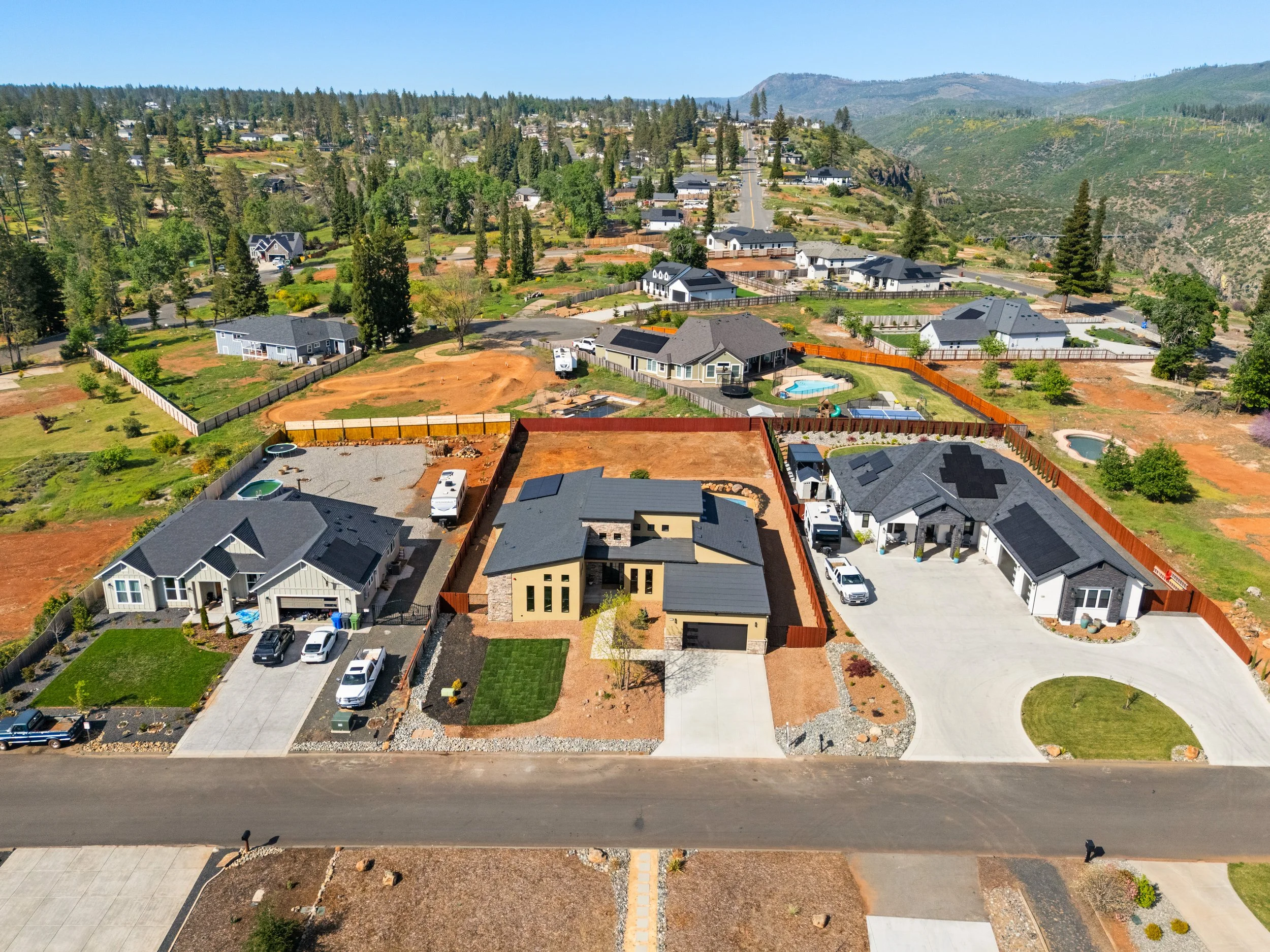
5093 Malibu Drive, Paradise, California. The home is complete. And so is Paradise, the trees are growing back, the canyon is as beautiful as it has ever been, and the community is rebuilding. Photo courtesy of Jordan Claverie
Jenny Mitchell
Founder, JMitchell Resilient Homes
Sources
• Camp Fire fatalities and structures destroyed: CAL FIRE — fire.ca.gov/our-impact/remembering-the-camp-fire
• Camp Fire displacement figures: FEMA Disaster 4407 — fema.gov/disaster/4407
• ICF construction history and performance standards: ICF Manufacturers Association — icf-ma.org
• Fire rating standard: ASTM E119-20 — manufacturer laboratory testing for ICF wall system
• Wind resistance standards: FEMA P-320 / ICC 500-2020
• Net Zero certification: PG&E — property-specific certification, 5093 Malibu Drive, Paradise CA
• Fire insurance quote: Farmers Insurance — property-specific policy, fire coverage only, excludes liability and other coverages
• Dave Marrs / ICF Builder Magazine: icfmag.com/2025/10/building-safer-smarter-hgtvs-dave-marrs-champions-icf-construction/
• RoofersCoffeeShop Podcast Transcript — the source of the California wildfire / six-inch concrete quote: rooferscoffeeshop.com/post/dave-marrs-rebuilding-smarter-with-icf-podcast-transcript
• ICF Builder Magazine article — "Building Safer & Smarter: HGTV's Dave Marrs Champions ICF Construction," October 2025: icfmag.com/2025/10/building-safer-smarter-hgtvs-dave-marrs-champions-icf-construction/
• YouTube video — "Dave Marrs Nudura ICF Home Build | Disaster Resilience," Nudura Insulated Concrete Forms, September 2025: youtube.com/watch?v=MLFWqtOvX34
• Roman Colosseum construction history: Britannica — britannica.com/topic/Colosseum