


Why Concrete Construction?
The homes we build start with reinforced concrete and that single material choice changes everything. Fire resistance, energy independence, sound insulation, structural strength, and insurability all follow from it.
Why Concrete? Why Now?
Concrete construction is not new technology. Reinforced concrete wall systems have been used in residential and commercial construction for over 50 years. In the Gulf Coast, the Southeast, and the Midwest, regions that face hurricanes and tornadoes concrete construction is well established. School districts in those areas build concrete schools specifically because the structures can serve as community shelters when a storm hits. The technology is proven, documented, and code compliant across every California jurisdiction.
What has been different about California is that concrete construction became associated with high end custom homes, a choice available primarily to buyers with larger budgets, at a time when construction costs here were already among the highest in the country.
That is what we are working to change. Resilient, fire resistant, energy independent homes should be accessible across a broader range of budgets because the people who need this kind of home most are often the ones who can least afford to pay a premium for it. Fire survivors are looking for a home that will not burn down again.
Concrete construction puts your home in a fire resistant category that conventional construction simply cannot match.
What Concrete Construction Delivers
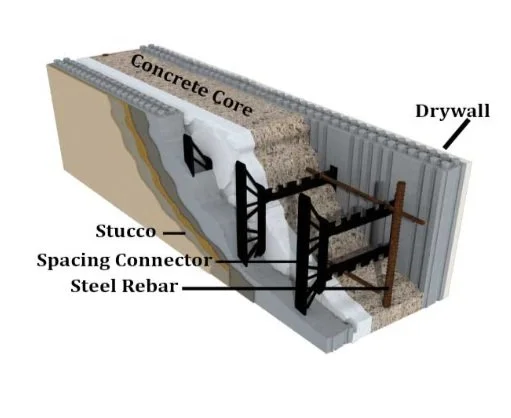
Our homes meet the ASTM E119-20 5-hour fire rating the most stringent standard available for residential wall assemblies. Four hours from the concrete and EPS core. One additional hour from 3-coat acrylic stucco on the exterior. The concrete core is non-combustible. The EPS foam insulation is fire retardant. The result is a wall that does not ignite, does not contribute to the spread of flames, and maintains structural integrity through fire exposure that destroys conventional construction entirely.
Fire rating: 5-hour — ASTM E119-20 (4-hour core + 1-hour Class A stucco)
Fire Resistance
Concrete structures are inherently resistant to wind, fire, and water damage. Our homes withstand 250 mph winds exceeding all hurricane and tornado codes. There is no rot, no pest damage, no structural degradation over time. Concrete gains compressive strength as it ages your home will be structurally stronger in 30 years than the day it was built.
Wind resistance: 250 mph — exceeds FEMA P-320 / ICC 500-2020
Strength & Durability
Reinforced concrete walls deliver R-22 to R-26 continuous insulation with zero thermal bridging roughly double the real-world performance of a conventional wall. The concrete core provides thermal mass that stabilizes indoor temperatures, dramatically reducing the load on heating and cooling systems. Our completed home at 5093 Malibu Drive runs $101–$168 per month in total utility costs for 3,358 square feet including pool operation with an owned 4.2 kW solar system that produces more energy than the home consumes. PG&E issues a monthly credit for the surplus.
Wall insulation: R-22 to R-26 — zero thermal bridging
Monthly utilities: $101–$168/month total — 3,358 sq ft including pool, Net Zero certified by PG&E
Energy Independence
Sound Insulation
Concrete walls deliver a Sound Transmission Class rating of 54. Conventional walls typically rate between 33 and 38. The difference is immediately noticeable the moment you walk inside the home is quieter in a way that is difficult to describe until you have experienced it. This contributes to a quality of daily life that only concrete construction can deliver.
Sound rating: STC 54 — vs. STC 33–38 for conventional construction
California's insurance market has changed permanently. Major carriers are exiting the state or declining conventional homes in fire-risk zones. A concrete home is in a fundamentally different risk category one that insurance actuaries recognize and price accordingly.
Our completed home at 5093 Malibu Drive received an actual Farmers Insurance quote for fire coverage at $2,800 per year — $4,000 per year total homeowners. Comparable conventional homes in the same area run $6,000–$12,000 or more for fire coverage alone when coverage is available at all. Concrete construction also qualifies for FHA, VA, and Fannie Mae green mortgage programs.
Fire insurance: $2,800/yr — Farmers Insurance, fire only, 5093 Malibu Drive
Total homeowners: $4,000/yr — all-incident coverage
Comparison: $6,000–$12,000+/yr for comparable conventional homes
Insurability-California’s Changed Market
Lower Cost to Own Every Month
The advantages of concrete construction are not only structural they translate directly into lower monthly costs over the life of the home. Lower utility bills. Lower insurance premiums. Lower maintenance. No exterior painting. No wood rot. No pest remediation. Systems that run less often and last longer because the building envelope around them is performing at a level conventional construction cannot match.
Over 30 years, the difference in operating costs between a conventional home and a concrete home in California is not a small number. It is measured in hundreds of thousands of dollars.
For the full cost comparison including utilities, maintenance, insurance, and 30-year projections for two actual California homes read our detailed breakdown:
What Industry Experts Are Saying
Concrete construction isn't being advocated by people trying to sell you something new. It's a proven building system that experienced contractors across the country are actively choosing for their own projects in their own communities, after their own disasters.
Dave Marrs - Host of HGTV’s Fixer to Fabulous
Dave Marrs is a contractor with over 20 years of residential building experience based in Northwest Arkansas, tornado country. After nine tornadoes swept through his area in a single night, he made a shift to concrete construction. He now promotes the technology publicly through his HGTV platform and social media.
In his own words:
"If I have a forest fire or the fires in California — this is a foam that is fire retardant, that will not burn like lumber will. If it does get through that first layer of foam, well now all of a sudden I've got six inches of solid concrete around my house."
"Give it a shot. You're going to create a safer home that's more efficient. Yes, it is a little bit more upfront cost, but a lot of that is given right back to you in sound quality, using half the size of a furnace because of the insulation and efficiency."
A note on that six inches…that's exactly what we build. Most ICF construction uses a four-inch concrete core. JMitchell Resilient Homes upgrades every home to a six-inch reinforced concrete core. It costs more to build. We think it's worth it, and so does Dave.
Note: This video is produced by Nudura, one of several ICF manufacturers. JMitchell Resilient Homes is not affiliated with or compensated by Nudura. We build with a variety of concrete wall systems.